

 Search
Search
[{{{type}}}] {{{reason}}}
{{/data.error.root_cause}}
{{{_source.title}}} {{#_source.showPrice}} {{{_source.displayPrice}}} {{/_source.showPrice}}
{{#_source.showLink}} {{/_source.showLink}} {{#_source.showDate}}{{{_source.displayDate}}}
{{/_source.showDate}}{{{_source.description}}}
{{#_source.additionalInfo}}{{#_source.additionalFields}} {{#title}} {{{label}}}: {{{title}}} {{/title}} {{/_source.additionalFields}}
{{/_source.additionalInfo}}How Immersive Sim Racing Experiences Are Changing the Way Gamers Train and Compete
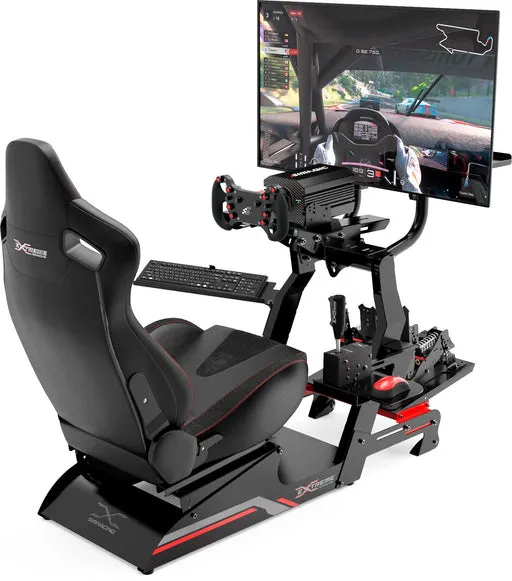
Over the last decade, competitive gaming has evolved far beyond casual entertainment. One of the clearest examples of this transformation can be seen in sim racing, where realism, precision, and skill development now sit at the center of the experience. What was once viewed as a niche hobby has grown into a serious training ground for esports competitors, motorsport enthusiasts, and even real-world drivers. Immersive sim racing experiences are no longer just about playing a game. They are reshaping how gamers practice, learn, and compete at high levels.
From casual gameplay to structured trainingTraditional racing games were designed primarily for fun. While they offered excitement and speed, they rarely demanded discipline or long-term skill development. Modern sim racing has changed that entirely. Today's platforms focus heavily on physics accuracy, tire behaviour, braking dynamics, and track realism. This shift has pushed players to adopt structured training habits similar to those used by professional athletes.
Gamers now spend time analyzing lap telemetry, refining racing lines, and practicing consistency rather than just chasing wins. Sessions are often planned with specific goals in mind, such as improving corner entry speed or managing tire wear. This structured approach has elevated sim racing from casual play into a performance-driven discipline.
Precision hardware and realistic feedbackOne of the biggest reasons sim racing has become a legitimate training tool is the hardware that supports it. High-quality steering systems, pedal sets, and cockpit frames allow players to experience force feedback and resistance that closely mirror real driving conditions. Every curb strike, weight transfer, and loss of traction is communicated through tactile feedback.
This level of immersion forces players to develop muscle memory and fine motor control. Unlike traditional controllers, precision equipment demands proper braking technique, smooth steering inputs, and consistent throttle application. Over time, these skills become instinctive, helping competitors react faster and make better decisions during races.
The role of immersive environmentsBeyond hardware, the environment in which players train has become increasingly important. Dedicated racing rooms, carefully designed lighting, sound isolation, and ergonomic seating all contribute to deeper focus. These spaces eliminate distractions and help players maintain concentration for extended sessions.
Experiencing a real-world sim racing experience can significantly accelerate learning. In these environments, racers are able to fully engage their senses, creating a mental state similar to real motorsport conditions. This heightened immersion improves reaction time, spatial awareness, and mental endurance, all of which are critical in competitive racing.
Data-driven improvement and analysisModern sim racing platforms generate detailed performance data after every session. Lap times, braking points, steering angles, throttle inputs, and sector comparisons allow racers to pinpoint weaknesses with incredible accuracy. Instead of guessing what went wrong, players can review objective data and make targeted adjustments.
This analytical approach mirrors professional motorsport training. Gamers learn to evaluate performance trends over time, identify inconsistencies, and make incremental improvements. As a result, progress becomes measurable rather than subjective, leading to more efficient training and faster skill development.
Bridging the gap between virtual and real racingOne of the most compelling aspects of modern sim racing is how closely it aligns with real-world driving techniques. The same principles apply whether racing virtually or on a physical track. Smooth inputs, proper weight transfer, braking modulation, and racecraft awareness are universally required skills.
Many aspiring drivers now use sim racing as a stepping stone into real motorsport. Even professional racers rely on simulation to learn tracks, rehearse race scenarios, and maintain sharpness during off-seasons. This crossover has reinforced the credibility of realistic racing simulators as legitimate training tools rather than mere entertainment devices.
Competitive mindset and mental conditioningSuccess in sim racing is not just about technical ability. Mental strength plays a major role. Competitive races demand focus, patience, and emotional control. A single mistake can undo an entire race, forcing players to manage pressure and recover quickly.
Through repeated exposure to high-stakes competition, sim racers develop resilience and discipline. They learn how to stay calm under stress, adapt strategies mid-race, and maintain consistency over long sessions. These mental skills translate well beyond gaming and mirror the mindset required in professional sports.
Accessibility and global competitionAnother reason immersive sim racing has grown so rapidly is accessibility. While real-world racing is limited by cost, geography, and logistics, virtual competition removes many of these barriers. Players from different countries can compete on equal terms, sharing tracks, rules, and conditions.
This global accessibility has created a highly competitive ecosystem where talent rises quickly. Gamers are exposed to diverse driving styles and strategies, pushing them to adapt and improve continuously. Training against skilled opponents from around the world accelerates learning far more effectively than isolated practice.
The future of competitive gaming and simulationAs technology continues to evolve, sim racing is likely to play an even larger role in competitive gaming and motorsport development. Improvements in physics engines, motion systems, and visual realism will further blur the line between virtual and physical racing.
At the same time, realistic racing simulation setups are becoming more refined, allowing players to tailor their environments to match professional standards. As these systems become more widely available, the gap between elite competitors and newcomers will increasingly be defined by discipline and training rather than access alone.
ConclusionImmersive sim racing experiences have fundamentally changed how gamers train and compete. What began as entertainment has evolved into a sophisticated ecosystem focused on skill development, analysis, and performance. Through realistic hardware, immersive environments, data-driven feedback, and global competition, sim racing now offers a training pathway that rivals traditional sports.
As more players embrace structured practice and long-term improvement, sim racing will continue to shape the future of competitive gaming. For many, it is no longer just about winning races. It is about mastering a discipline that demands precision, focus, and continuous growth.
When you subscribe to the blog, we will send you an e-mail when there are new updates on the site so you wouldn't miss them.
About the author

Follow Us!


-
Verse of the Day - Isaiah 26:3
You will keep in perfect peace him whose mind is steadfast,
...
Donate
Please consider supporting our efforts. Since we're a 501 C3 Non-Profit organization, your donations are tax deductible.
Join Our Discord

Who's Online
We have 10297 guests and no members online
Comments